PPAAI — Policy Preparation using Agentic AI
Early signal detection for public policy
An agentic AI system that continuously monitors heterogeneous data sources, surfaces emerging patterns before they become visible in official figures, and helps policymakers understand developments earlier, and more clearly.
PPAAI is currently applied to the domain of entrepreneurial climate at the Dutch Ministry of Economic Affairs. It monitors policy themes within this domain and continuously surfaces signals that may indicate emerging policy-relevant developments. This is done by a system built around three core components that operate together in a continuous feedback loop. At the core is an agentic AI architecture: multiple specialised AI agents operate simultaneously, each with a defined role.
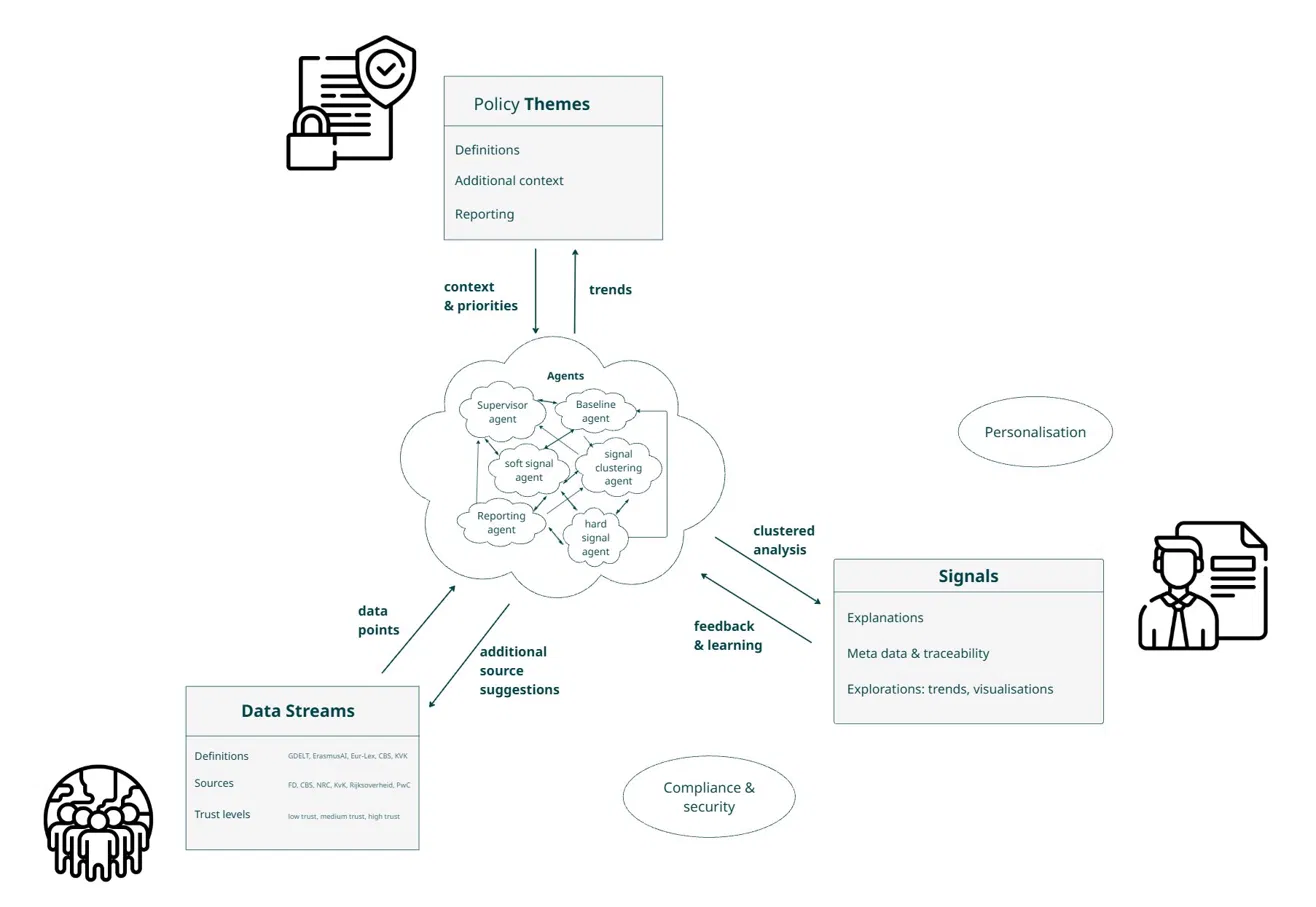
Policy themes
Specific areas of interest, defined by the Ministry of Economic Affairs, that form the context within which the system operates.
Data streams
Pipelines through which data enters the system, each drawing from a range of underlying sources.
Signals
A detected deviation: a cluster of related data points — drawn from any mix of sources — that together point to a potentially relevant development.
(1) Policy themes
Each theme contains a definition, a context representation, relevant key terms, and theme-specific data, providing the agents with the context and priorities they need to interpret incoming data meaningfully. The layer is not static — detected signals and observed trends feed back into it over time, keeping the thematic context current. A policy officer reviews suggested refinements before they take effect.
(2) Data streams
The system integrates structured statistics and registrations alongside news articles and academic papers. Hard data is verified, structured, time-stamped (KvK, CBS, RVO) — reliable but retrospective. Soft data is qualitative and unstructured (news, sentiment, framing, narratives) — less reliable but often real-time. Either data type can ground either kind of signal; the classification depends on what the signal claims, not where the data came from. Each source carries a trust label so the reliability of any signal is always explicit.
(3) Signals
It is precisely this grouping that adds meaning — a single data point may be inconclusive, but a cluster reveals a development worth investigating: that's why we call it a signal. A particularly important pattern is divergence: when soft signals (interpretive readings) point one way while hard signals (citable facts) point another, the gap between them is itself worth paying attention to.
The three components do not operate in a fixed sequence. They are continuously connected by the agentic system — a set of specialised AI agents that simultaneously monitor incoming data, detect deviations, and translate findings into signals. As signals emerge, they feed back into the themes layer; as the context evolves, it sharpens how new data is interpreted; as data streams are processed, the system can suggest new or additional sources. The result is not a pipeline that runs from left to right, but a living system that continuously updates, enriches, and improves itself.
Throughout this process, the policy officer remains in the loop — reviewing suggested refinements, labelling signals, and adding context that the system cannot infer on its own. Every step is logged. Every inference is visible.
Transparency and explainability by design
In policymaking, where decisions carry far-reaching societal consequences, responsible use of AI is non-negotiable. The system is built around three core principles:
Full traceability
Every analytical step, every data source, every inference, logged and visible. Not just what was concluded, but how and why.
Trust labels
Each source carries a reliability rating. The system never hides uncertainty — if a signal is weak, that is stated explicitly.
Human in the loop
The policy officer remains in control. The system signals and presents options. It does not conclude, decide, or act autonomously.
Because signals can be based on less reliable soft data, the system is not designed to assert that something is definitively true. The appropriate framing is always: this is worth looking into. The policy officer, equipped with domain knowledge, decides how to act — monitor the signal, escalate it, consult an expert, or set it aside for now. The system is a directional early-warning instrument; a support to policymakers, not a substitute for them. The ambition is not faster conclusions, but earlier awareness.